Cinema, at the beginning, was a man walking. He was filmed by Marey, in profile, dressed in white against a black background. An unforgettable image: a new form of expression was born. Movement, at last.
But that man had barefoot.
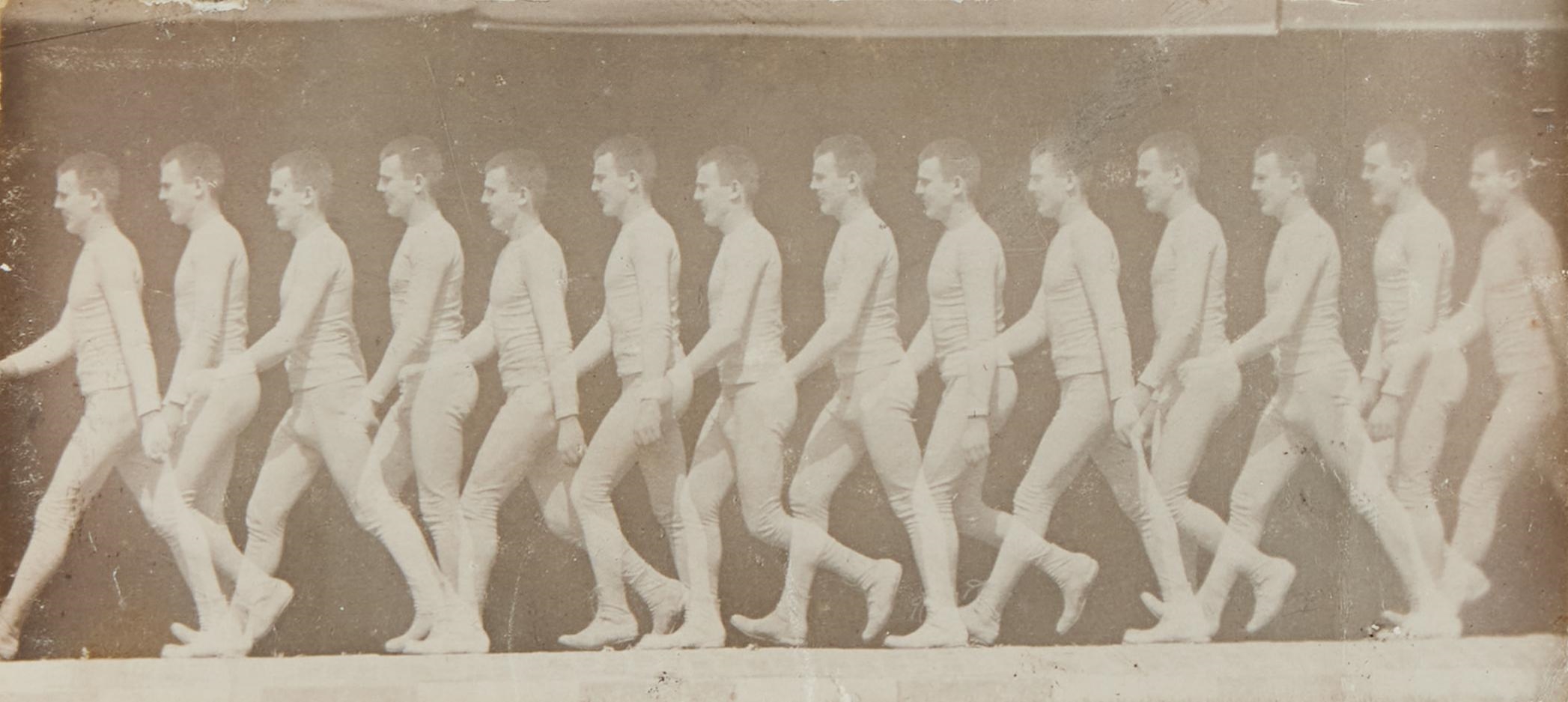
In his chronophotographs, the man wears light shoes, conceived to make the movement visible.
Carrière (author of the article presented here) turns him, through a poetic license, into the archetype of the “barefoot man”, a metaphor for cinema in its early days (Ed. note)
Cinema thus began by walking beyond its own shoes. From time to time, it still happens: a face, or the upper body, is filmed without showing the feet. The actor takes advantage of it to take off his shoes (it makes less noise), or to slip on lifts if, though a star, he remains a little too far from the sky.
Soon enough, however, the feet took their revenge. One could even say that cinema gave them, first or almost, the power of speech — to the point that, at times, only they are filmed: the silent advance of a killer’s patent-leather shoes down a hotel corridor, the swaying of a high heel hesitating to fall from the tip of a silk stocking, the trampling of a barbaric boot, the white satin slippers dancing on a clown’s heart: well-shod feet can say everything.
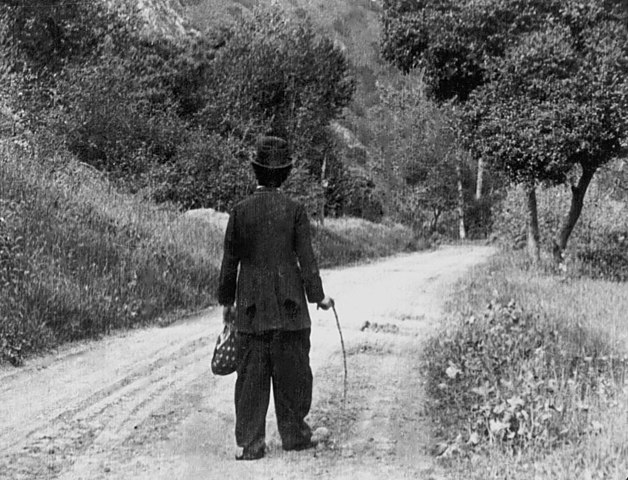
At times, they even steal the scene from faces. Chaplin’s enormous shoes, inherited from the circus and the paths of misery, give him his gait, his silhouette, and even his soul. It is a way of saying that there exist, on this earth, giants capable of filling those shoes.
Buñuel said that we should be grateful to Louis Malle, among others, for revealing to us Jeanne Moreau’s gait in Elevator to the Gallows. A gait he later made his own in Diary of a Chambermaid, under the banner of fetishism. Here the shoe, or more precisely the little boot, an object of passion and collection, fills the wardrobes of an old gentleman. It is his only object of love, one that has taken the place of a living woman. A woman who is there only to put them on for a moment, to give them that sensual movement. Soon after, the man will carry the beloved boots to his room, pressed against his heart, a secret treasure that will lead him to his death.
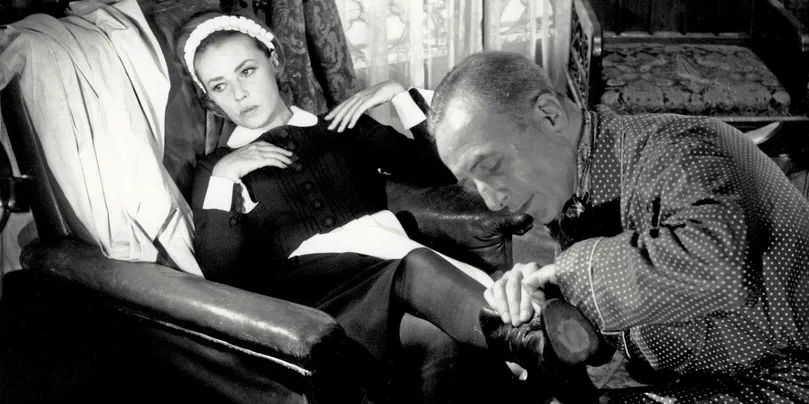
In this sequence, shoe fetishism becomes a symbol of desire — a theme also evoked by Jean-Claude Carrière in the text presented here. (Ed. note)
After all, shoes keep their secrets. Pedro Almodóvar tells us so in his own way in High Heels. But the translated title does not fully convey all the echoes of the Spanish one. Tacones lejanos (“distant heels,” “heels that move away”), lets us hear that utterly unique sound of women’s high heels: a sound once heard in childhood, which life gradually erases from memory.
In cinema, shoes can be used to kick someone’s backside, to drink champagne as in Stroheim’s films, to run, to dance, to drive men mad, and even to feed them (Chaplin again, in The Gold Rush). They carry highly coveted microfilms, state secrets, leave treacherous footprints in the sand as well as in the snow, and, in certain James Bond adventures, conceal deadly daggers.
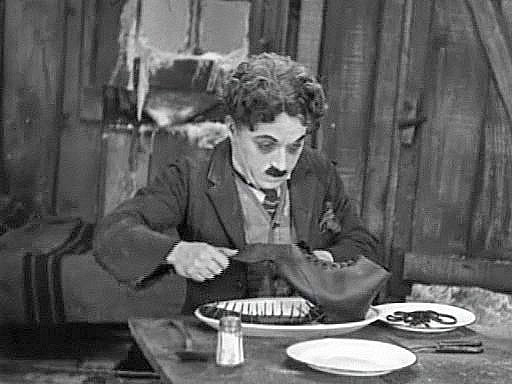
The famous scene in which the Tramp cooks and eats his shoe.
I almost forgot: they are also made for walking. To rest upon the earth, to go from one point to another. The man dressed in white whom Marey filmed has slipped his feet into every shoe in the history of the world. And tomorrow, in all likelihood, he will walk again.
« Footwear Tells the Story of Cinema »
Editorial title, translation, and photographic/bibliographic research by Barbara Placidi
Text by Jean-Claude Carrière
included in the preface to the exhibition catalogue
« CHAUSSURES et CINÉMA – créations de l’atelier Pompei »
Musée International de la Chaussure, Romans (Francia)
3 February – 2 June 1996
Published by Musée International de la Chaussure, Romans
 facebook
  instagram
  x
x